Survival
Your opponent loses when their Life Deck empties. They also lose if unresolved damage remains and their deck contains only Dragon Balls.

The Buu Saga rules, built for your browser. Search a ruling, follow a turn, or check damage without leaving the table.
DRAGON BALL ARENA / DIGITAL RULEBOOK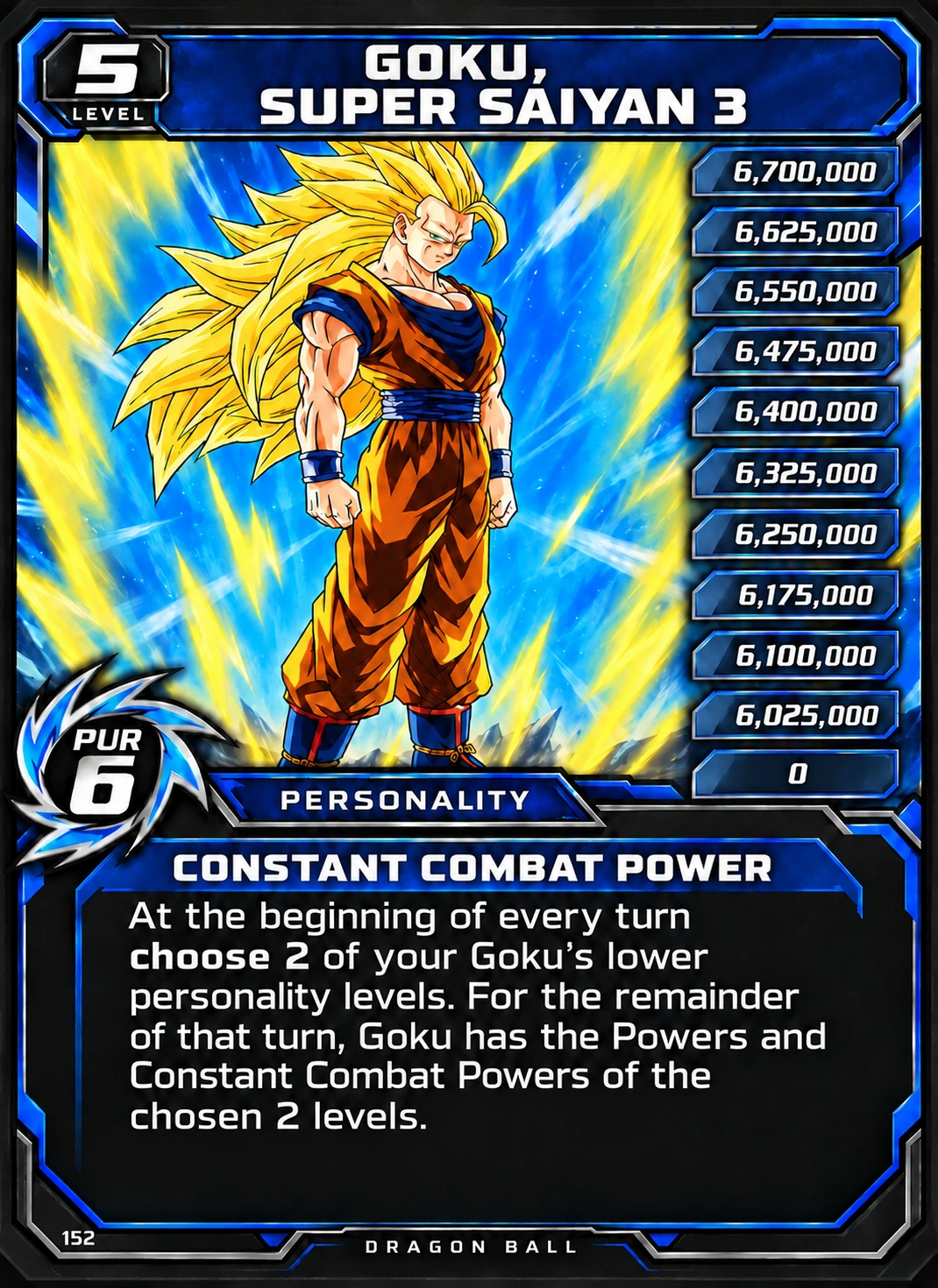
Buu Saga · printed pages 20, 43–44
Your opponent loses when their Life Deck empties. They also lose if unresolved damage remains and their deck contains only Dragon Balls.
Control all seven of one type. Playing the seventh wins immediately; capturing it requires holding all seven until the start of your next turn.
Advance your Main Personality to the highest MP level available in this game. If your opponent has a higher maximum level, your lower maximum cannot win this way.
Buu Saga · printed pages 21–22, 48
Remove Battle Simulator-only cards. A villain starter, or a deck using Kid Trunks as MP, removes the starter’s Kid Trunks Ally. Choose the standard or High-Tech version of each MP level, not both. A multi-level High-Tech card requires using all levels printed on it.
Use Load deck for your starting cards. The MP, Mastery and Sensei slots run left to right. Resolve Double Power and choose the first player manually.
Buu Saga · printed pages 23–28
The active player draws three cards from the top of their Life Deck.
The active player may put Allies, Dragon Balls, Non-Combat cards, Drills, Battlegrounds and Locations into play.
Increase MP stages by its Power Up Rating (PUR), plus one for a declared Tokui-Waza. Each Ally gains one stage regardless of PUR. Never exceed maximum stages.
Choose whether to enter Combat. Playing a Battleground or Location this turn requires skipping Combat.
Resolve entering-Combat effects for the active player, then the opposing player. The opponent draws three; players alternate actions until both pass consecutively.
The active player discards down to zero or one card, then the opponent does the same.
If the active player did not declare Combat, they may move their top discard face down to the bottom of their Life Deck. Then the turn changes hands.
The table’s Next step indicator guides the turn. Players still resolve card effects and exceptions.
Buu Saga · printed pages 24–29, 49
The active player remains the active player for the whole turn. Attacker and defender are roles that switch after each action. After both players resolve entering-Combat effects and the opponent draws three, the active player takes the first action.
Perform an attack; activate an eligible effect instead of attacking; or pass. Attacks can come from hand cards, an MP power, or the Ally controlling Combat. Other actions can use eligible personality, Non-Combat, location or Sensei powers. An action without an attack skips the defense phase.
When attacked, play or activate an eligible card or power that stops the attack or prevents its damage, or do nothing. A card that only ends Combat cannot be used as a defense unless it also directly stops or prevents an attack. An unstopped attack counts as successful even if its damage is zero.
A normal pass does not prevent you from acting later. Combat ends when both players pass back to back, or an applicable effect ends it.
Once per Combat, discard any hand card to perform a physical attack using the Physical Attack Table. Afterward, you must pass for the rest of Combat and cannot use normal defenses. Existing Defense Shields and floating effects may still stop attacks.
Buu Saga · printed pages 32–33
Use this order for each attack. Secondary effects happen before the opponent responds; costs, attacks, blocks, Endurance and successful-hit effects are separate parts of the sequence.
Buu Saga · printed pages 25, 28, 34, 38–39, 48
Use the power rating printed at each personality’s current stage, not their number of stages above zero. If a physical attack gives a fixed damage amount, use that instead of the table. A plus sign adds to base damage.
Base damage only. Apply modifiers, defenses and damage routing separately. A Z rating on either side makes base damage 2.
| ATK / DEF | A | B | C | D | E | F | G | H | I |
|---|---|---|---|---|---|---|---|---|---|
| A · 0 | 1 | 0 | 0 | 0 | 0 | 0 | 0 | 0 | 0 |
| B · 1–349,999 | 2 | 1 | 0 | 0 | 0 | 0 | 0 | 0 | 0 |
| C · 350,000–1,299,999 | 3 | 2 | 1 | 0 | 0 | 0 | 0 | 0 | 0 |
| D · 1,300,000–2,399,999 | 4 | 3 | 2 | 1 | 0 | 0 | 0 | 0 | 0 |
| E · 2,400,000–3,549,999 | 5 | 4 | 3 | 2 | 1 | 0 | 0 | 0 | 0 |
| F · 3,550,000–4,749,999 | 6 | 5 | 4 | 3 | 2 | 1 | 0 | 0 | 0 |
| G · 4,750,000–5,999,999 | 7 | 6 | 5 | 4 | 3 | 2 | 1 | 0 | 0 |
| H · 6,000,000–7,299,999 | 8 | 7 | 6 | 5 | 4 | 3 | 2 | 1 | 0 |
| I · 7,300,000+ | 8 | 8 | 7 | 6 | 5 | 4 | 3 | 2 | 1 |
An ordinary energy attack costs two stages and deals four life cards unless its text changes those values. Pay first; a stopped attack does not refund its cost. You cannot perform an attack whose cost you cannot pay. Energy Combat cards that are not energy attacks have no automatic two-stage cost.
For stage damage, lower the receiving personality’s stages to a minimum of zero, then take one life card for every unpaid stage. Life damage comes from the Life Deck, including when an Ally receives damage. For example, four stage damage against two remaining stages causes two stages lost and two life cards of damage.
Buu Saga · printed pages 29–30
Anger cannot go below zero. At five or more, advance one MP level, reset anger to zero without carrying over excess, set stages to maximum and discard your Drills. Only your current MP level is in play.
Personality powers normally work once per turn during Combat. Each actual level change makes the current MP power available again, even on returning to a previously used level. A constant Combat power must apply while that personality controls Combat.
A card effect can lower your MP level. Keep your current anger, set the lower level to five stages above zero, and discard your Drills.
If your maximum level cannot win Personality victory, reaching five anger there instead resets anger and maximizes stages. This does not change levels, discard Drills, or refresh the personality power.
Buu Saga · printed pages 48–52
When a card is revealed as attack damage from your Life Deck, you may use its Endurance to prevent that many remaining life cards of damage. The revealed card itself has already counted as damage; remove it from the game if you use its Endurance. Unused prevention does not carry forward.
You must have declared Tokui-Waza to use Endurance. It cannot come from your hand, cards in play or earlier discards. It cannot prevent non-attack life loss or damage that cannot be prevented. It can apply even if the attack removes damaged cards from the game. Endurance X uses the condition printed on that card. Reducing actual damage below five can prevent a life-card Dragon Ball capture.
A matching shield automatically activates when you have not stopped an attack. It stops that attack; if several shields are available, choose their activation order. Focused attacks and attacks whose damage cannot be prevented activate all matching shields and pass through them.
A focused attack cannot be stopped by Defense Shields, Masteries or a card that stops both physical and energy attacks. An appropriate defense that only stops that one attack type can stop it. You may play an otherwise eligible defense for its secondary effects even if it cannot stop the focused or unstoppable attack.
Buu Saga · printed pages 35–37, 47–48
Play an Ally during your Non-Combat step at three stages above zero. Its level must be no higher than your current MP level. Later, overlay its next consecutive level and set it to maximum stages; only the top level remains in play. An overlay can exceed your current MP level.
An Ally may take control when your MP is at zero or one stage above zero. Its rating then determines attack-table damage, and it may use its power even if the MP already used theirs. Choose the defending personality before resolving a defense; keep the acting personality in control until that attack finishes.
When an opponent plays or uses a card outside their defense phase, an eligible Ally may take control before its effects. Another Ally or the MP can later take over without waiting for the current Ally to reach low stages. Allies cannot use entering-Combat powers. Constant powers apply only while controlling Combat. Anger effects always affect the MP.
An Ally can receive stage damage for another personality even without controlling Combat. Calculate damage using the personalities actually in control, then route it. One recipient takes the entire attack’s stage damage; you cannot split it between Allies. Overflow still damages your Life Deck.
An Ally cannot be the same character as either player’s MP. Both players can have the same Ally character at different levels, but normally no duplicate character and level may be in play. Allies match their MP’s hero/villain alignment; Majin MPs and Majin Allies must be paired. Rogue Allies inherit the MP’s alignment.
Rogues in this edition: Android 16, Android 18, Piccolo, Vegeta and Majin Vegeta. See the special personality rules for Saibaimen and Cell Jr. exceptions.
Buu Saga · printed pages 29, 39–42
A title beginning with Red, Blue, Orange, Black, Saiyan or Namekian identifies a styled card. Other cards are Freestyle. A character name makes a card Named; this does not by itself restrict who may use it. Follow any explicit character-only restriction.
Physical Combat, Energy Combat and Combat are distinct card types. They are generally played from your hand during Combat for their stated purpose. Place regular Non-Combat cards in your Non-Combat step, activate them when eligible, and discard after use. Dragon Balls follow their own rules even if printed with a Non-Combat heading.
Play Drills during Non-Combat. They stay in play after use; most have mandatory ongoing effects. Your styled Drills must all share one style, with no duplicate copy of a styled Drill in play. Freestyle and Named Drills can coexist with styled Drills and can have multiple copies within deck limits.
Discard your Drills whenever your MP actually gains or loses a level. When you draw a Drill incompatible with the style of your existing Drills, you may immediately reveal it and shuffle it into your Life Deck, without a replacement draw. A Drill’s added damage applies even if the attack did not originally deal that damage type.
A Drill that prohibits other Drills of its stated style cannot enter while one is anywhere in play. If another Drill of that style enters afterward, discard the restricted Drill. If the same restricted Drill enters, discard both.
Play these during Non-Combat, then skip Combat for that turn. You can still rejuvenate. Only one Battleground or Location is in play across the table: a new one removes the previous one from the game. You cannot play another copy of the same one already in play.
Buu Saga · printed pages 42–45
Your deck may contain only one type: Earth, Namek or Dende, with at most one of each number. Alternate Dende versions count as the same numbered ball. A duplicate cannot be in play anywhere on the table. Play them during Non-Combat and resolve their powers as instructed.
A Dragon Ball headed for the discard pile bypasses it: remove it from the game if that ball is already in play; otherwise place it face down at the bottom of your Life Deck. During attack damage it does not count as a damaged card, so continue revealing. For non-attack life-card loss it does count toward the required loss. If damage remains and your deck contains only Dragon Balls, you lose.
You may capture a different type from your own deck’s type. At capture, choose all or none of the ball’s powers. A captured ball’s previous floating effect ends and is granted to its new controller only if they choose its power. Ownership never changes.
Placing your seventh matching ball into play wins immediately. Capturing your seventh wins only if you still hold all seven at the beginning of your next turn.
Effects must specifically mention Dragon Balls to affect them. Random effects may still reposition them inside a deck or discard them from a hand. A generic search for a card cannot select a Dragon Ball.
Buu Saga · printed pages 45–48, 50, 52
A Sensei may be used for its power without a Sensei Deck. To have a Sensei Deck, include a Sensei and stay within its printed capacity. Starting contents must be Fusion personalities or cards marked for a Sensei Deck. Fusion personalities count toward capacity but cannot be swapped into the Life Deck at setup.
Choose and reveal all cards to swap first. Set those aside, move the same number of original top Life Deck cards into the Sensei Deck, then shuffle the chosen cards into the Life Deck. Offer a cut afterward. You can inspect your own Sensei Deck at any time; your opponent cannot. Its cards are outside play, but are not removed from the game.
Use at most one Mastery. Its style must match a qualifying declared Tokui-Waza. It starts in play, counts toward deck size and remains in play. Its effects originate from the Mastery itself.
For styled Tokui-Waza, all styled cards in the deck must share one style, with at least one styled card beyond the Mastery. Freestyle cards may be included. Your Sensei Deck must also match the style or be Freestyle. Freestyle Tokui-Waza and its Mastery require no styled cards. Declaring a qualifying Tokui-Waza gives the MP +1 PUR and enables Endurance.
Saiyan Tokui-Waza MPs: Bardock, Broly, Cell, Future Gohan, Gohan, Goku, Goten, Gotenks, Kid Trunks, Majin Vegeta, Mighty Mask, Nappa, Raditz, Trunks and Vegeta.
Namekian Tokui-Waza MPs: Cell, Dende, Lord Slug, Nail, Piccolo and Pikkon. Pikkon may declare this style but cannot use Namekian Heritage-only cards. Namekian Tokui-Waza permits a 90-card deck.
Buu Saga · printed pages 47–49
Tournament banned/restricted lists and later errata are format-specific. This guide preserves the supplied Buu Saga baseline; agree on any later format changes before playing. The table’s import warnings are not a full legality check.
Buu Saga · printed pages 27, 39, 48–55
Resolve secondary effects before the opponent’s response, even if an attack is later stopped. A successful-hit effect waits until after damage and captures. If effects offer an “or” choice, choose one; otherwise resolve the effects in written order within the battle sequence. When both players would resolve effects together, the active player resolves theirs first, then the opponent.
Use-when-needed effects can happen between the fifteen battle-sequence parts, not in the middle of one. If an effect affects that card, finish the effect before using the card. Outside Combat, use them when needed.
A duration-based floating effect lasts until its specified endpoint even after its source card is discarded. When that is the card’s final effect, discard the card after creating it, except personality cards.
Declare Empower when paying for an attack. It adds its number as life-card damage while ignoring all card text after the Empower instruction for that attack. Read the whole card before choosing.
When selecting cards from your Life Deck, show the chosen cards and shuffle afterward. Revealed cards without a destination instruction return to their original location in their original order. Face-down cards stored beneath another card are discarded when that parent leaves play unless its text says otherwise. Italic explanatory parentheses are outside ordinary effect timing.
Buu Saga · printed pages 37, 51–55
Use an effect allowing two matching-level, fusible personalities to fuse. Take the corresponding Fusion personality of that level from your Sensei Deck. It replaces the pair as one personality, at maximum stages and zero anger. An MP fusion becomes your MP; an Ally-only fusion is one Ally. Component identities still count for applicable game effects and character-specific targeting.
At the start of each of your turns, place your top Life Deck card beneath the anger counter as a timer. At five or more cards, immediately defuse: remove the Fusion personality from the game, return both component personalities at maximum stages, and shuffle the timer cards into the Life Deck. A Fusion may use either component’s character-only cards.
Vegeta and Majin Vegeta, Trunks and Kid Trunks, and Gohan and Future Gohan are separate characters. Do not combine their MP levels or share their character-only permissions. Named cards still allow the normal three copies unless they match your MP.
Saiyan Heritage: Broly, Cell, Cell Jr. 1 and 2, Future Gohan, Gohan, Goku, Goten, Gotenks, Kid Trunks, Majin Vegeta, Mighty Mask, Nappa, Paragus, Raditz, Trunks and Vegeta. Older cards restricted to villains, Goku and Gohan use this heritage rule.
Namekian Heritage: Cell, Cell Jr. 1 and 2, Dende, Lord Slug, Nail and Piccolo. Heritage eligibility and Tokui-Waza eligibility are different lists.
Saibaimen permit duplicate Allies: up to three copies of each card in a deck and nine across the field, with three at each level. If Saibaimen is an MP, no Saibaimen Allies are allowed.
Cell Jr. Allies require a Cell MP and allow duplicates, with up to nine across the field. Cell Jr. 1 and Cell Jr. 2 are distinct; overlay the matching character’s next level. The later clarification in this rulebook says Cell Jr. cards are not Cell’s Named cards, so they do not receive the four-copy Named allowance.
Ginyu Force as MP counts as four Allies for effects, but those counted Allies cannot absorb redirected damage. As an Ally it counts as one personality. With a Ginyu Force MP, its individual members cannot appear as Allies, and member cards cannot form its MP stack. Ginyu Force is villain-aligned.
Mighty Mask similarly counts as one Ally for game effects. It is distinct from Goten and Trunks, can declare Saiyan Tokui-Waza and use Saiyan Heritage, Goten-only and Kid Trunks-only cards, but cannot fuse into Gotenks.
Majin Yakon’s X PUR copies the opposing MP’s current printed PUR. Against another Majin Yakon, both have PUR 1. In multiplayer, choose which opponent’s MP to copy.
How to use this site
Drag one of your cards onto your play area. Drop it where you want it to stay. On a phone or tablet, drag with one finger; move near the upper or lower screen edge to scroll. The other player receives the position when you drop.
You can also tap a card, choose a destination in the Card Inspector, and select Move card.
Select any visible card to inspect it. For your cards in play, use Flip to change which side your opponent sees, or Mark used as a reminder. You can still see the identity of your own face-down cards.
Draw 3 and Draw 1 move cards into your private hand. Search Life Deck opens your private search panel; finish with Finish search & shuffle. The opponent sees that you are searching, but cannot see the search results.
Use the plus and minus buttons beside your counters. Changing the MP level does not automatically resolve every associated rule: make the other required adjustments yourself. Ally stages are available through the Card Inspector.
Solo practice lets you switch between both seats. In a private room, Copy invite gives you a link for your opponent. Both players load decks before the host starts setup.
Use the game log and chat to explain the action, compare the relevant card text, and agree on the correction before continuing. This arena helps track the game; it does not adjudicate every card interaction.
Buu Saga · printed pages 20–60
An independently written digital guide to the original Score Entertainment DBZ CCG, using the 2003 Buu Saga rulebook supplied for this project. Printed page references identify the source locations. Later errata, tournament formats and house rules can differ. Game mechanics here are explained for play; the arena does not automatically adjudicate them.
Rules credit: Score Entertainment, Buu Saga rulebook (2003). Archive credit: LackeyCCG and RetroDBZccg. Unofficial fan guide; Dragon Ball names and artwork belong to their respective rights holders.
No matching rules. Try fewer words, or .